WhatsApp Chaos, Dodgy Bibs, and Pure Brilliance: Inside Britain's Glorious DIY Football Underground
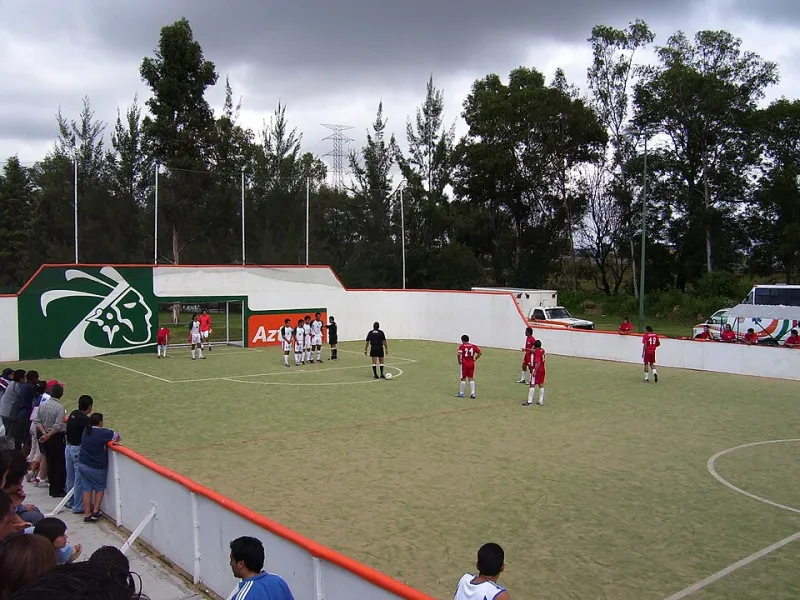
Photo: Mario Ortegon, CC BY-SA 3.0, via Wikimedia Commons
WhatsApp Chaos, Dodgy Bibs, and Pure Brilliance: Inside Britain's Glorious DIY Football Underground
The league table is handwritten in blue biro, slightly smudged where someone's thumb caught it while it was still drying, and taped to a noticeboard between a flyer for a Zumba class and a lost cat poster. It lists twelve teams. Three of them have names that can't be fully reprinted here. One is simply called "The Lads." Nobody is entirely sure who runs it, how the fixtures were decided, or what happens if there's a dispute.
This is competitive football in Britain, 2025. And it is absolutely glorious.
The League Nobody Runs (And Everyone Loves)
Five-a-side has always existed in the gaps — the Tuesday evenings, the Sunday mornings, the damp Thursday nights under flickering sports hall lights when grown adults convince themselves they are, in fact, still very good at football. But something has shifted in recent years. What was once a loose arrangement of mates kicking about has quietly evolved into something resembling an actual sporting ecosystem.
Across Britain, thousands of self-organised leagues are operating entirely outside any official structure. No FA affiliation. No registered referees. No insurance paperwork. No pompous committee meetings in draughty function rooms. Just a WhatsApp group, a booking at the local leisure centre, and the collective willpower of twenty or thirty people who refuse to let their football days be entirely behind them.
"We started it because we couldn't get a regular game sorted any other way," explains Marcus, who organises a twelve-team Tuesday night league in Coventry that has been running for four years without a single official document being signed by anyone. "First season it was chaos. Someone booked the wrong hall. We had seventeen people turn up and no goalposts. We played with jumpers. It was brilliant."
The WhatsApp Group: A Civilisation in Miniature
If you want to understand the soul of British DIY football, you need to spend some time in one of these WhatsApp groups. They are, without exaggeration, some of the most entertaining places on the internet.
Any given week will contain: three people confirming they're available, two people cancelling at the last minute (one of them blaming "work," one blaming "the missus," both lying), a lengthy debate about whether last week's goal actually crossed the line, someone posting a meme entirely unrelated to football, and at least one passive-aggressive message about who owes money for the pitch booking.
There is always someone who is technically the organiser but has never formally agreed to be the organiser. They collect the money, chase the stragglers, and rebook the pitch when someone inevitably forgets. They receive no thanks. They would be devastated if anyone else took over.
"I've been running ours for six years," says Priya, who organises a mixed five-a-side group in Bristol. "I've tried to hand it over twice. Both times it collapsed within a fortnight and I had to take it back. I think I'll be doing this until I physically cannot walk."
She says this with complete contentment.
The Rules (Such As They Are)
One of the most charming aspects of Britain's DIY football underground is the extraordinary variety of rules in operation simultaneously across different leagues, often within the same sports centre.
Some leagues play no-contact. Others have a gentleman's agreement that contact is fine as long as you don't make it obvious. Headers might be banned, or allowed, or "frowned upon." Goalkeepers might be permitted, or everyone takes turns, or nobody wants to go in goal so you just play without one and hope for the best.
Kevin runs a six-team league in a car park in Manchester — yes, an actual car park, on Saturday mornings, using portable goals that live in his boot — and has developed what he describes as "a completely unique offside rule that nobody fully understands, including me."
"We tried to explain it to a new player last month," he admits. "Three of us gave three completely different explanations. All of us were confident we were right. We just moved on."
This is entirely normal. The beauty is that it works anyway.
More Competitive Than You'd Think
Don't make the mistake of assuming this is all casual kickabout energy. Some of these leagues are ferociously competitive in ways that would alarm anyone who wandered in expecting a friendly.
There are teams with matching kits, ordered from a discount sportswear website at a total cost of about £80, who take the biro league table extremely seriously. There are players nursing genuine grievances from fixtures that happened two seasons ago. There are managers — people who have appointed themselves manager of a five-a-side team with no contract, no budget, and no authority — who give actual team talks.
"Our captain did a whiteboard session before a semi-final last year," says Danny, a regular in a Leeds sports hall league. "A whiteboard. For five-a-side. Against a team called The Wobble Merchants. I've never been more proud to be part of something."
Why It Matters More Than It Looks
Behind all the chaos and comedy, something genuinely important is happening here. Britain's DIY football leagues are, in their anarchic way, delivering exactly what sport is supposed to deliver: community, physical activity, competition, and belonging — without a single penny of public funding, without a single piece of government strategy, and without anyone's permission.
For millions of people who have aged out of formal club football, who can't afford season tickets, who find the officialdom of organised amateur sport off-putting, these self-built leagues are the only game in town. Literally.
They are imperfect, chaotic, occasionally maddening, and absolutely essential. Long may the biro smudge. Long may the WhatsApp notifications pile up on a Tuesday morning. Long may someone somewhere be explaining an offside rule that doesn't quite make sense.
Britain's football underground is alive, it's loud, and it has absolutely no plans to apply for planning permission.